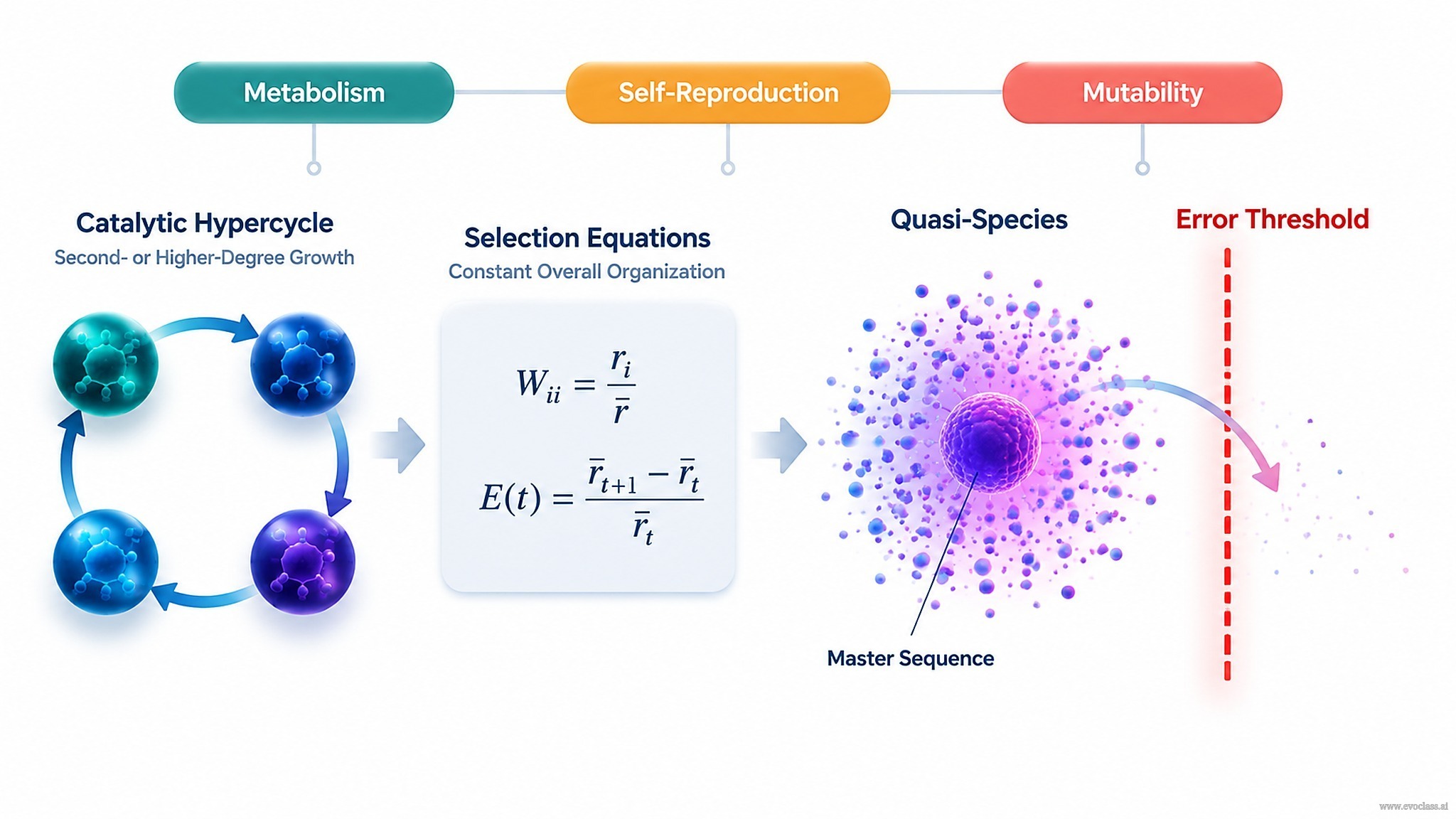
This lesson opens with a question central to origins-of-life theory: how can a set of self-replicative molecules generate molecular selection without preexisting cellular machinery? The answer developed here is the catalytic hypercycle: a cyclic linkage of self-replicative units in which each unit’s replication is catalytically supported by another member of the cycle. The result is collective self-organization, not a collection of independent replicators.
Three growth organizations
- Plain catalytic growth: an external catalyst promotes replication of a template, but the catalyst is not itself produced by the same loop. The growth law is not self-amplifying.
- Autocatalytic growth: a molecule catalyzes its own replication or that of its own kind. The growth rate contains a term proportional to the first power of the replicator concentration—first-degree self-amplification.
- Hypercyclic growth: replication is organized as a closed cycle A → B → C → ... → A. Since each member is produced under catalysis by another member, the overall growth depends on products of at least two concentrations. This is why catalytic hypercycles are systems of second or higher degree.
The distinction matters because only the hypercyclic organization couples self-replication to a collective, nonlinear dynamic that can support selection at the molecular level.
Darwinian prerequisites
For molecular selection to occur, three conditions must be met:
- Metabolism: a source of free energy and material to maintain the organized state away from equilibrium.
- Self-reproduction: the capacity of the units to multiply, so that advantageous variants can increase in number.
- Mutability: heritable variation, without which there is no substrate for selection.
These three prerequisites are boundary conditions: they do not by themselves specify the quantitative dynamics, but they define the domain in which a Darwinian description is meaningful.
Selection equations under constant overall organization
When the total concentration of replicators is held constant, the frequencies
Here Wii is the selective value of replicator type i, incorporating its replication and degradation rates. E(t) is the average excess productivity, the population-weighted mean of the selective values. A type increases in frequency when its W_ii exceeds E(t) and decreases when it falls below E(t). The constant-organization condition makes selection a relative comparison rather than an absolute growth race.
Mutation-selection balance and the quasi-species
Real replication is error-prone. Mutation-selection balance does not yield a single dominant wild-type sequence; instead it produces a quasi-species, an organized distribution of mutant sequences centered on a master sequence. The wild type is therefore the most probable member of a cloud of related sequences, not the unique target of selection. The distribution is stable when the selective advantage of the master sequence balances the mutational flux away from it.
The error threshold
The quasi-species can persist only if the mutation rate per replication is low enough. Beyond the error threshold, the master sequence cannot transmit its information reliably, the mutant cloud delocalizes, and the organized distribution collapses into a mutationally randomized state. This limits how much information a hypercycle or quasi-species can maintain reproducibly. The opening roadmap—catalytic cycle → selection equations → quasi-species → error threshold—thus links molecular self-organization to the fundamental information ceiling of Darwinian evolution at the molecular level.
Catalytic hypercycle roadmap
A closed catalytic hypercycle leads into the selection equations with selective value Wᵢᵢ and average excess productivity E(t), then into the quasi-species cloud and the error-threshold barrier. The three Darwinian prerequisites—metabolism, self-reproduction, and mutability—frame the transition from molecular self-organization to molecular selection.